Tripodos, number 59 | 2026|
ISSN: 1138-3305
Received: 15-06-25
Accepted: 16-03-26
OnlineFirst: 12-05-26
Final publication:
Doi.org/10.51698/tripodos.2026.59.08
End of Memories: Coming-of-Age, Love, Loss, and Friendship. Ludonarrative Writing in Indie Games about Asia-Pacific
Alberto Porta Pérez
Jaume I University (Spain)
The article explores ludonarrative writing about several Asia-Pacific indie video games, focusing on titles that subvert traditional narratives to foreground experiences centred around teenage protagonists with darker or more challenging aspects. We analyse A Space for the Unbound (Mojiken Studio, 2022) (Indonesia), Last Time I Saw You (Maboroshi Artworks, 2024) (Japan), and Until Then (Polychroma Games, 2024) (Philippines). These ludofictions address adolescence, the anguish of the search for identity, and the difficulty of fitting into society, all within game worlds where reality is shaped by fantasy elements represented in pixel art aesthetics or through hand-drawn illustrations. Gameplay mechanics vary, from puzzle solving and combat to platformer-style navigation or decision-making based on visual novels. This article seeks to identify distinctive artistic styles and regional or national identities that shape their ludonarrative writing, with a particular focus on framing, playability, and identification.
Keywords: ludonarrative, coming-of-age, teenage, indie, Asia.
El artículo explora la escritura ludonarrativa sobre algunos videojuegos indie de Asia Pacífico, centrándose en títulos que subvierten narrativas tradicionales para potenciar experiencias centradas en protagonistas adolescentes con lados más oscuros o desafiantes. Analizamos A Space for the Unbound (Mojiken Studio, 2022) (Indonesia), Last Time I Saw You (Maboroshi Artworks, 2024) (Japón) y Until Then (Polychroma Games, 2024) (Filipinas). Estas ludoficciones abordan la adolescencia, la angustia por la búsqueda de la identidad y la dificultad para encajar en la sociedad, todo dentro de mundos ludoficcionales donde la realidad se ve afectada por elementos de fantasía representados en una estética pixel art o a través de dibujos hechos a mano. Las mecánicas de juego varían, desde la resolución de puzles y combate hasta la navegación tipo plataformas o la toma de decisiones basada en visual novels. Con esta investigación buscamos identificar estilos artísticos distintivos e identidades regionales o nacionales que configuran su escritura ludonarrativa, concretamente el encuadre, la jugabilidad y la identificación.
Palabras clave: ludonarrativa, coming-of-age, adolescencia, indie, Asia.
It’s not easy for the player to embody Atma’s body on their journey of self-discovery during their high school years, all while uncovering the anxiety and depression suffered by their best friend, Raya. Nor is it easy to live as Ayumi, who experiences her first romances while coping with family problems. Or as Mark, who can not find enough reasons to turn in homework on time at a high school that makes him feel insecure day after day, unable to answer: “Who Am I?”. And if navigating adolescence were not enough, these three protagonists must do so in the presence of supernatural powers, monsters, and ghosts. These three premises belong to three indie video games that explore adolescence following ludonarrative patterns that we aim to explore in this research.
The boundaries that determine where the term “indie” in the video game industry begins and ends are increasingly blurry, if they were ever clear. Game Studies has discussed this “exceptionally elusive term, as we are constantly having difficulties in explaining its meaning” (Garda and Grabarczyk, 2016), generally linked to financial, creative, or editorial independence. It is also not easy to define or categorize ludofictions by region or country in an increasingly globalized and cross-border sector (Anyó, 2023). For all these reasons, we want to highlight the difficulty of video game research within a framework where genre and subgenre labels fluctuate and are sometimes contradictory.
For this research, we identified indie games by their originality and transgression against industry standards. We also looked at how their game design emphasizes “relation to essential aspects of the content, such as the main character’s psychology, their relationship with the represented world and certain underlying themes” (Pérez-Latorre, 2016, p. 24). Our focus is not on market competition or resources. Instead, we are interested in indie video games that do not face self-censorship or institutional pressure, allowing them to “can therefore explore more sensitive topics such as rape, racism, incest, cancer, depression, transsexuality, etc.” (Trépanier-Jobin, 2016, p. 117). Therefore, we selected our case studies by seeking titles where designers were able to express themselves and become involved on an ideological and emotional level (Pérez-Latorre, 2016).
Beyond focusing on productions from studios “without the resources of large global companies or association with major global publishers”1 (Anyó, 2023, p. 4), we are also examining video games set in the Asia-Pacific region or which depict parts of this vast territory. Our goal is to identify distinctive artistic styles and regional or national identities that shape their ludonarrative writing. This refers to “the audiovisual construction of the resulting product”, which is fundamental to video game design even though, ironically, “little attention has been paid to it from academia” (Martín-Núñez, 2021, p. 370). As Marta Martín-Núñez argues, and as we will contend in this research, “the expression of the video game lies in how it is viewed [...] beyond where it is viewed from” (Martín-Núñez, 2021, p. 370). We are investigating all of this while also considering that our case studies are appealing to a foreign and Western audience —not just as players, but also as researchers. This is precisely because they expose a “supposed authenticity” (Grau de Pablos, 2023, p. 6) of the local. As Tomás Grau de Pablos argues in his research on Japanese indie games, which can be extended to other Asian-Pacific nationalities, the appeal of authenticity is maintained when players are evoked with folklore, an era, or a time “that reminds them of their childhood or an idealized period of the medium” (Grau de Pablos, 2023, p. 6). Throughout the article, we will argue how our case studies not only exude a nostalgic atmosphere through various elements interwoven into the ludonarrative design but also do so through a teenage avatar that is crucial for a gameplay experience centred around coming-of-age, love, loss, and friendship.
This research therefore aims to (1) contribute to the analysis of video games that represent a very local geographical context, which deserves greater attention, and (2) highlight the relationship between audiovisual language —framing— gameplay, and identification in order to explore narrative themes such as, in this case, nostalgia and the transition into adulthood. We’ve chosen A Space for the Unbound (Mojiken Studio, 2022), designed by a studio in Surabaya, Indonesia; Last Time I Saw You (Maboroshi Artworks, 2024), developed in Osaka, Japan; and Until Then (Polychroma Games, 2024), designed by a small Filipino studio, as our primary case studies. It is worth noting that the ludofictional worlds (Planells, 2017) these games are based on are an idealized reflection of their respective nations. For example, A Space for the Unbound presents a rural Indonesia in the 1990s, Last Time I Saw You offers a reimagined vision of 1980s Japan, and Until Then takes players on an adventure in the Philippines of 2014. Adding to our specific interest in investigating these titles with teenage protagonists, a bundle recently appeared on the digital distribution platform Steam featuring our three case studies, titled “End of Memories”, highlighting their similarities under tags like “coming-of-age”.
We wish to clarify that, although these games depict specific locations within the Asia-Pacific region, their designers or developers do not necessarily originate from that region. For instance, the game set in Japan was developed by a company based in Osaka, yet its principal developers are of Spanish origin. As discussed in the following sections, it has become increasingly difficult to identify studios whose authorship or headquarters can be explicitly associated with a single country.
METHODOLOGY: FRAMING, PLAYABILITY AND IDENTIFICATION
To conduct this research, we employed a methodology for analysing video games (Fernández-Vara, 2019; Cuadrado-Alvarado and Planells, 2020), their signification (Pérez-Latorre, 2012), and their grammar (Navarro-Remesal, 2016). Specifically, we focused on issues of framing and gaze design —what we see and from where we see it (Martín-Núñez, 2020; Anyó and Colom, 2021). This collective articulation produces “certain dramatic intentions that are executed in real time” (Martín-Núñez, 2021, p. 370), which are then subverted in the ludonarrative. In this case, the goal is to enhance gameplay experiences centred around wounded protagonists during their maturation process. Additionally, we applied the analytical gameplay technique, combining our own gaming experience with external sources (Aarseth, 2007). Specifically, we consulted developer interviews and gameplays from other players, analysing how they play and react to specific elements of the game’s design.
In the analysis of our case studies, we will, as we mentioned, focus on the set of forms and sensibilities defined by the game design elements that evoke an aesthetic experience in the player (Sicart, 2008); a dialectical space as the axis of ludofiction where we can “observe in detail the most relevant aspects of the work and interpret them” (Terrasa-Torres, 2022, p. 38). In this study, we focus on issues of artistic design and design of the gaze, addressing not only what is shown —what the game emphasizes or what it invites us to reflect on, for instance— but also how —the manner in which these audiovisual constructions are presented to us. Or, in other words, we conduct an analysis “around the relationship between framing, playability, and identification” (Martín-Núñez, 2021, p. 370), concerning the power granted —or withheld— through the gaze and the management of perspective, as well as audiovisual editing as an articulating element of the video ludic text (Martín-Núñez, 2021, p. 370.
On one hand, we address the limits of the image, or framing, encompassing both what is within the frame and what is deliberately left out. This contributes to generating emotional tension with the on-screen and off-screen space (Anyó and Colom, 2021, p. 90). This configuration is in line with the genre and its influences, which aim to “offer the player the best possible view to overcome obstacles and enjoy the playable experience” (Martín-Núñez, 2020, p. 80). Rune Klevjer argues that, from both game design and narrative perspectives, in most cases the control of three-dimensional environments is configured as a vehicle for exploration through which the player sees and is fictionally represented (2012, p. 35). Furthermore, it amplifies “emotions associated with the pure narrative enjoyment resulting from gathering all the information necessary to understand a story presented in bits and pieces” (Anyó and Colom, 2021, p. 90). Clara Fernández-Vara points out that “the story can remain the same while the player explores fragments of a story, which they can reassemble like a puzzle” (2020, p. 71). This is precisely possible in the video game medium due to the need for external intervention in the system: the player. Therefore, when we talk about framing, we not only revisit concepts inherited from cinematic language, but we also discuss a playable gaze. That is, as players, we move through space in a specific direction while being able to look around us, or in other words, “visually explore the space while physically traversing it” (Martín-Núñez, 2020, p. 82).
On the other hand, and related to the above, we have the term gameplay, which is understood as a player’s construction made possible by the game rules, and which “is frequently effective for achieving a specific objective in the game” (Pérez-Latorre, 2012, p. 131). We know that “players have a central role in the development of the plot, which conditions their experience in the fiction world, a learning process that ideally provides a balance between failure and success” (Anyó and Colom, 2021, p. 93). It is no surprise, then, that the space designed for this activity contributes to player enjoyment and ensures the stability and self-sufficiency of the fictional world (Planells, 2017). This construction is possible through the relationship between player and avatar; a relationship developed in response to the game’s appearance “through an unrestricted semiotic of visual design, animation, text and music” (Burn and Schott, 2004, p. 230). These authors advocate the idea of a multimodal avatar that relates to the narrative —the heavy hero— and has the capacity to act within the system —the digital dummy— (Burn and Schott, 2004, p. 230). The configuration of the avatar and its relationship with the player determines a gameplay experience that will always be unique and non-replicable. In other words, no two playthroughs will ever be the same because, ultimately, the relationship between player and avatar is an intimate and personal matter.
Finally, Lluís Anyó and Àngel Colom emphasize the importance of the character, especially in narrative video games where “is the trigger, the force that sets the story in motion” (2021, p. 90). Some research points to player immersion in ludofiction, but as has been argued elsewhere in Game Studies, “the possibility of immersing oneself in a story, of crossing the boundary, is a characteristic of any fictional form, be it literary, audiovisual, or videoludic” (Colom, 2023, p. 61). Ultimately, immersion “is earned by an evolving craft-practice which is constantly adapting, extending, and refining complex sets of shared social and media conventions” (Murray, 2020, p. 24). We prefer, therefore, to speak of identification, understood as “the relationship between the player’s extradiegetic actions and the character’s intradiegetic actions” (Anyó and Colom, 2021, p. 93). Jon Robson and Aaron Meskin (2016) argue that video games are a medium that enables the deployment of “self-involving” fictions, which are about the players themselves insofar as they engage and act within a (ludo)fiction. For their part, Matthew Carlson and Logan Taylor propose the concept of “Fictional Proxy” to highlight how the player is responsible for the actions of their character, “and thereby makes sense of the way in which players talk about their gameplay experiences, and of the sense of moral responsibility that gameplay can engender” (2019, p. 18). It should be added that studying identification is problematic due to its affective component, which is not measurable and depends primarily on the player’s level of engagement.
In summary, when we delve into the three case studies and try to answer the question “Who am I?”, we do so by considering framing, playability and identification (Table 1). The combination of these elements determines the gaming experience and the relationship between ludofiction and the player, and vice versa. It is not just about answering what the proposals from three different countries —Indonesia, Japan, and the Philippines— tell us, but how they tell us.
Table 1. Three key elements of ludonarrative writing by Martín-Núñez (2021)
|
Ludonarrative Writing |
Description |
Questions |
|
Framing |
To analyse the frames created by virtual cameras, viewpoints and the playable gaze. |
What is shown and what is hidden? How does this affect the player and their emotions? |
|
Playability |
Interaction between player and character/avatar within the rules of the game. |
What can the player do in the fictional game world? How does the player’s agency influence the narrative? |
|
Identification |
Relationship between the player’s extradiegetic actions and the character’s intradiegetic actions |
Does the video game encourage the development of a bond between the player and the character? |
Source: Own elaboration.
INDIE GAMES IN (PART OF) ASIA-PACIFIC
Decades ago, academia already pointed out the absence of studies focusing on the Asia-Pacific market that moved away from the American or European perspective (Hjorth and Chan, 2009), which was almost exclusively written and published in English (Wolf, 2015). In fact, during this research, we have observed how the majority of scientific publications are primarily focused on Japan, South Korea, and China. These markets have traditionally been characterized by “diverse consumption and production patterns of gaming, mobile and broadband technologies, subject to local cultural and socio-economic nuances” (Hjorth and Chan, 2009, p. 3). Fortunately, in recent years, we have detected a trend towards analysing the nationality of video games from multiple disciplines (Wolf, 2015). However, as other authors argue, any “project that analyses the nationality of a game (and the always dangerous idea that this is measurable) will have to carefully navigate the minefield of material conditions and cultural markers” (Navarro-Remesal et al., 2024, p. 19). If in this article we delve into that “minefield” it is because we seek in these indie games “the repetitions, obsessions, and conflicts that run through them” (Navarro-Remesal et al., 2024, p. 19) and, in turn, it allows us “to understand contemporary global flows and the role gaming cultures play in an age of participatory, crossplatforming and collaborative media whereby rubrics such as ‘players’ and ‘industries’ are transforming” (Hjorth and Chan, 2009, p. 13).
It is important to note that we do not consider each case study to be representative of its country and the indie market, nor is that the aim of this article. We hope this analysis serves as a starting point for further, more in-depth research. Similarly, we have omitted many other Asian-Pacific countries —whose video games have a significant presence on platforms like Steam, Epic Games, and GOG— due to limitations. Below, we will try to outline the context of the indie market in Indonesia, Japan, and the Philippines while analysing each case study.
INDONESIA: A SPACE FOR THE UNBOUND
As has occurred in other regions, the video game market has been divided into three waves: console games, online games, and smartphone games. In Indonesia, however, the third wave “emerged during the 2000s, marked by the booming of smartphones in Indonesia” (Rakhmani and Darmawan, 2015, p. 251) and continues to be very popular and “is extending beyond its initial base of young, urban users” (p. 254). MMORPG titles like Ragnarok Online (Gravity, 2002) were highly popular, becoming a cultural phenomenon. The emergence of platforms like Steam, which promote digital distribution and foster the coexistence of independent video games with big-budget titles in the same ecosystem (Fiadotau, 2024), allows us, as players, to discover titles such as A Space for the Unbound. This game brings us closer to the cultural markers, desires, and fears of a specific society within a ludofiction infused with strong elements of fantasy. If, as Larissa Hjorth and Dean Chan argue, “by exploring gaming cultures in the region, insight can be gained into new forms of modernity —cross-cultural consumption and production processes— and how the region is shifting and evolving” (2009, p. 4), it also contributes to fostering an understanding of other cultures from a purely humanistic perspective. We mentioned that a single game cannot be representative of a country, much less for Indonesia, which is “a developing country with two hundred ethnic groups and six religions acknowledged by the state” (Rakhmani and Darmawan, 2015, p. 263). Nevertheless, A Space for the Unbound strives to place the player in a decipherable nostalgic context regardless of their country of origin, as we will reinforce in the following section on Japan.
A Space for the Unbound places us in rural Indonesia in the shoes of Atma, a high school student who repeatedly dreams of his own death. Alongside his best friend, Raya, the player discovers what the town is like beyond the high school, its people, and their relationships. In a context of poverty and a seemingly realistic world, Atma begins to witness paranormal occurrences that question his reality. Little by little, his best friend’s personality darkens, revealing a villain who destroys each of the characters standing between her and the protagonist in an unreal world. The player discovers that Raya is, in fact, in a coma after attempting suicide, and that Atma, her avatar, is merely a divergent creation whose purpose is to help her wake up.
This Indonesian game, like many other titles close to the graphic adventure genre, features “markedly linear narrative structures, and thus the interactive dimension affects how easily players advance through the narrative more than the structure of the narrative itself” (Anyó and Colom, 2021, p. 93). It is a pixel art game with a side-scrolling perspective. While there is a map to help players orient themselves, movement is limited to horizontal progression. What is shown is clearly intentional on the part of its designers: residential streets highlight class differences, local shops evoke nostalgia —like a video rental store or an arcade— and there are natural, partially abandoned spaces. The objects that bring this ludofictional Indonesia to life are clearly marked by the 1990s, especially anything related to technology.
The main mechanics of this title are combat —which pays homage to the side-scrolling arcade fighting genre— and Atma’s power to delve into the minds of certain characters to heal them through puzzles. The notebook he obtains in his reality allows him to help people who, for some reason, are not behaving as society expects. By accessing their psyche, the player must solve a puzzle to heal the victim. Through this gameplay, key themes surrounding mental health and nostalgia are experienced.
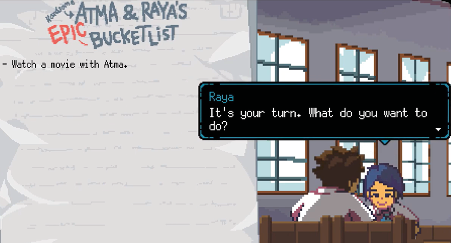
Lastly, the role of identification plays a fundamental part in A Space for the Unbound. Although the player takes control of Atma, he is just an avatar that has come to life. The real Atma died by drowning in that recurring dream that the player participates in at the start of the game. Thus, while the protagonist’s personality and motivations reflect the original Atma, they are ultimately constructed by the player and their involvement with the ludofiction. The game presents scenarios in which the player can make trivial decisions through dialogue. The simple act of, for example, co-writing the “Atma & Raya’s Epic Bucketlist” at the beginning of the game provides a space where the player projects their order of priorities within the fiction (Figure 1). In the end, the list contains the same elements for all players, but the order is determined by each player according to their preferences and how they wish to reflect part of themselves in the protagonist avatar.
Figure 1. A Space for the Unbound (Mojiken Studio, 2022)
Source: Steam.
A Space for the Unbound is an indie title that explores and (re)presents societal problems not only from Indonesia —and not just from the 90s— such as academic pressure, family conflicts, trauma, and depression. The ludonarrative writing presents, through an idyllic and romanticized past —at least visually— and a teenage protagonist —with school problems and existential doubts about an uncertain future—, a macro-context that is problematized and resolved through fantasy elements. We observe that time jumps, the absence of information, or the protagonist’s amnesia encourage player participation in reconstructing a story and trying to achieve the best outcome for the person who becomes, at least temporarily, their best friend.
JAPAN: LAST TIME I SAW YOU
Translating the indie concept in Japan is not easy when it competes with a second term —dōjin Soft or dōjin gēmu— which sparks debate both inside and outside the country (Fiadotau, 2019), for consumers and developers alike. Some games that straddle these definitions include Rainy Season (Inasa Fujio, 2020), A Tavern of Tea (npckc studio, 2019) and ママにゲーム隠された (Mom hid my game, hap Inc, 2017)2. Research surrounding gēmu, in addition to the international indie scene, has helped publicize the term dōjin and its differences from indie games. Martin Picard highlights the former as usually amateur creations, encompassing both original ideas and derivative works, though “they are particularly well known in this latter form, as fan fictions” (2021, p. 26). Other authors point to the international distribution of these titles, with dōjin being more limited to the Japanese market (Grau de Pablos, 2023). It happens, however, that certain dōjin video games have succeeded outside of Japan, which is why “we should not essentialize indie and dōjin games as respectively Westernand Japanese or equate their cultural presence with their locales of origin” (Fiadotau, 2019, p. 66). This very particular scene in the Japanese market demonstrates how “the Asia-Pacific provides an exemplary case study on one of the most buoyant and yet culturally divergent regions in the world” (Hjorth and Chan, 2009, p. 1).
Just as we mentioned in the previous case how the pixel aesthetic was able to describe a rural Indonesian village in detail, in Last Time I Saw You it is worth noting its hand-drawn graphics and its characteristic manga/anime style, which “have added their own elements and personality to gēmu” (Navarro-Remesal and Loriguillo-López, 2015, p. 9). While the side-scrolling works in the same way as in the other case studies, the Japanese approach is influenced by the local history of the industry, which “evolved aesthetically from, or at least inherited traits from, manga and anime” (Navarro-Remesal and Loriguillo-López, 2015, p. 11), as well as by a disinterest in “grand narratives of worlds, but rather for the little narratives that are constructed to allow affective responses to characters” (Picard, 2021, p. 28). Usually, the characters are designed to be appealing for players in gēmu; for readers in manga; and for viewers in anime. We can see this in the attractive design of the Yokai and other fantastic creatures that the player associates with the Japanese media-mix and the otaku subculture (Picard, 2021, p. 28). Unlike mainstream games, the indie market, as we have argued before, allows its developers to take certain risks, and in Last Time I Saw You we detect this in its ludonarrative writing.
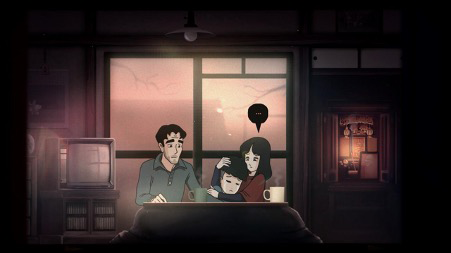
Ayumi is grappling with his first teenage problems, which challenge his identity. When the player takes control of this twelve-year-old boy, a typhoon is approaching the small Japanese village where he lives, bringing with it a curse. Ayumi can explore his home, his neighbourhood, and other places that make up his routine, like the school. And although the game “share thematic, tonal, and narrative traits, to the point that we could expand the notion of manganime to mangēmunime” (Navarro-Remesal and Loriguillo-López, 2015, p. 11), we identify themes that are not usually addressed in more popular gēmu or with such precision. Thus, players see how all family problems affect a child’s growth into adolescence: family pressure due to parental expectations, the feeling of misunderstanding that arises in adolescence, the silent grief over his recently deceased grandfather, and other issues of lineage inherited from parents to children. Unlike other mainstream video games, in Last Time I Saw You we encounter scenes in which the player can express their affection toward their parents or friends. These sequences are framed in a way that highlights affection at the centre, surrounded by lighting and its absence. The colours used convey cozyness, even when the emotions that surface are sad (Figure 2). These small gestures facilitate the player’s identification with their preadolescent character.
Figure 2. Last Time I Saw You (Maboroshi Artworks, 2024)
Source: Steam.
In this maelstrom of emotions the player must contend with, Ayumi discovers that his dreams are connected to a fantasy world where he falls in love with a girl. In this narrative layer, rich with fantastical elements, the mangēmunime elements unfold: Yokai —kappas, smart-crows, and other talking animals— magic, and curses. At the same time, in both the real and magical worlds, the game showcases cultural elements of Japan: from its architecture to the folklore and mythology that shape its customs and beliefs. For example, to save your game, you have to find and interact with a shrine. All these cultural markers are a draw for Western players who idealize Japan in an increasingly globalized world, but this idealization should not endorse or promote forms of Westernization or Japanism based on Orientalism (Consalvo, 2016; Idone-Cassone, 2020).
In all three case studies, there is a clearly intentional design to evoke a sense of nostalgia in the player, even when Western players have not experienced that childhood or adolescence in Asian-Pacific settings. As Víctor Navarro-Remesal and Beatriz Pérez-Zapata (2025) argue regarding Gagex titles, these games offer nostalgia for the unlived and for others’ memories because they evoke universal past experiences: a familiarity that enhances a postmodern sense of homelessness. It is particularly interesting how, in the specific case of Last Time I Saw You, the awareness of the impossibility of returning to the home of the past, with those deceased relatives or in places that no longer exist, emerges in Ayumi as a form of bitter nostalgia during his evolution into adolescence. The game achieves this through its playability: through those dreamlike adventures and the obstacles and puzzles he must face. What is more, the growing sense of emptiness, which he will not be able to completely soothe, is counterbalanced by the discovery of positive feelings: his first love, or the strengthening of his best friends.
Maboroshi Artworks’ offering is interesting to investigate further precisely because it emanates elements characteristic of gēmu while leveraging the experimental space offered by the indie and globalized market. Here, the ludonarrative writing strives to build a recognizable audiovisual atmosphere similar to that of a cozy game, but adapting mechanics and perspectives from other genres, such as platformers, albeit with reduced mechanical difficulty. It is even more interesting to note that, as is the case with much of modern video game production, the development team is not entirely Japanese. In the case of Last Time I Saw You, the main creators are people who live or have lived in Japan for many years, but whose nationality is different. This undoubtedly influences the ludonarrative writing, as it is a perspective shaped by multiple viewpoints that highlight certain Japanese cultural elements and transform them into the language of video games.
PHILIPPINES: UNTIL THEN
Mark is fifteen years old and lives alone at home because his parents work abroad. The player, who begins this interactive fiction with the promise of being set in the Philippines in 2014, soon discovers they are in a dystopia where the world seems to have changed after a global catastrophe. The fragmentation of space-time becomes a recurring theme in this investigation, much more akin to A Space for the Unbound, alluding here to a generational trauma. This is possibly a reflection of the various global crises of our century that primarily afflict new generations.
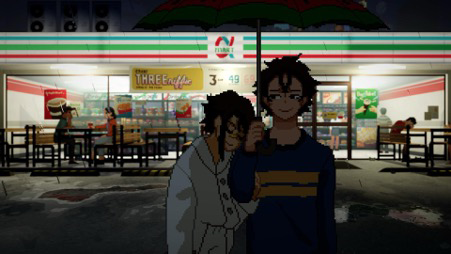
Until Then is presented as a visual novel where player choices determine the course of the story. Its aesthetic stands out for the use of pixel art with partially three-dimensional environments (Figure 3); that is, the camera changes location within the same scene, allowing the player to view the same space from multiple angles. Furthermore, the static framing characteristic of 2D side-scrolling games —which only moves with the character’s walking— takes on a more dynamic role here, imitating a shoulder-mounted or tracking shot and employing camera angles more typical of cinema. In fact, the studio highlights “a Cinematic Visual Experience”3 in their proposal. Split screens are also commonly used for moments when the mobile phone is in use: this way, Mark can read and write in chats with other characters or interact on their social media profiles. Generally, camera control is partially removed from the player, and this, by design, offers, in return, “the most suitable shot to generate a specific feeling” (Martín-Núñez, 2020, p. 83).
Figure 3. Until Then (Polychroma Games, 2024)
Source: Steam.
The dedicated attention to art design in Until Then is not random in a country where the industry has specialized in game art, 3D animation, and video games since 2001 (Escribano-Manzano, 2016). After the lifting of the ban on video game use in the Philippines, developers in the country have traditionally provided their services to design video games for foreign companies. Consequently, in 2016, the Filipino share in the global video game market was still anecdotal (Escribano-Manzano, 2016). This situation makes it difficult to trace the footprint of Filipino video games in relation to Asia-Pacific and to foster dialogue with the rest of the world. Despite this contextual void, which we also detect in research on the indie industry in the Philippines, we can attempt to unravel Until Then’s narrative writing, always bearing in mind that “in contrast to Japan and to some extent Korea, many developing Asian markets have not yet developed culturally-unique products with a universal appeal” (Tschang, 2009, p. 37).
When Mark navigates the game world in Until Then, players often try to identify elements around him with other Asian cultures, primarily Japan, due to its global video game industry heritage. Sometimes, it is not just about identifying and deciphering cultural nuances, but also recognizing recurring spaces, like convenience stores4. This situation is common in countries without a long tradition in cultural industries, as “nor have they created universally-appealing forms of popular culture, be it science fiction, fantasy or alternate reality genres of literature or film, that can be turned into video games and other creative products, let alone a domestic ‘style’ of games or animation” (Tschang, 2009, p. 37).
However, themes of maturity, love, loss, and friendship are universal, allowing every player to identify with the plot and characters of Until Then and its extensive dialogues. Visual novels, a legacy from Japan that for years were practically unknown in the West (Navarro-Remesal and Loriguillo-López, 2015), are “choice-based games with branching narrative featuring prose passages to tell their stories” (Finley, 2022, xix). Their consequences make the game challenging and feel “alive and believable” (Finley, 2022, p. 95). Scripted or branching-narrative titles “relies primarily on the preauthored progression of the game’s story elements to generate the experience” (Formosa et al., 2016, p. 213), giving designers broad control over the sequence of events. This allows them to consciously engage with sensitive themes or situations where they “can give the player more incentive to role-play a consistent moral identity” (Formosa et al., 2016, p. 221). Therefore, in Until Then, we also find a meticulously crafted treatment of choices, decisions, and branching narratives, further articulated through the game’s perspective and framing.
Lastly, it is worth considering how the player’s choices are presented, as this is also a matter of ludonarrative design. We have observed that the most significant and extensive opportunity for players to control Mark’s responses is through the smartphone. In this type of dialogue, it feels more natural for the player to pause and consider their answers. While Until Then, like other narrative and decision-based video games, uses a linear-branching narrative with multiple endings (Pérez-Latorre, 2012; Finley, 2022), the interesting aspect is providing space and response to player agency. This means it “is not about selecting between options in this case, but is instead about expressing intent, and receiving a satisfying response to that intent” (Tanenbaum and Tanenbaum, 2009, p. 9). The player needs to feel heard —even when their decisions do not have major consequences on the ludonarrative— to reflect on, in this case, trauma, anxiety, or trauma from the perspective of a confused and lost teenager.
This Filipino video game strongly resembles the Indonesian title, both in its pixel art style and its themes of coming-of-age and loss. However, the two offerings take different paths that are worth highlighting. While A Space for the Unbound leans into a late 20th-century nostalgia affected by fantasy elements more typical of puzzle films, Until Then uses the dystopian genre, starting from the year 2014, barely a decade from when this article is being written. This game relies on elements the player links to the retro, at least technologically —those mobile phones are now obsolete—, and even revives narrative conflicts more characteristic of 20th-century television science fiction, such as disappearances and subsequent investigations by groups of teenagers who act as saviours but are profoundly wounded.
CONCLUSIONS TO THE BEGINNING OF MEMORIES
Conscious that the lack of research on indie video games in certain Asian-Pacific countries, which are increasingly present in the global market, has limited this study, we can try to draw some conclusions, at least as a new starting point for the future. We insist that our interest in classifying video games by nationality has no greater ambition than to investigate the presence of distinctive artistic styles, as well as regional or national identities that shape ludonarrative writing.
From the perspective of framing, playability, and identification, we conclude that all three case studies use the adolescent character —their anguish in the search for identity and how to fit into society— as the main link with the player, who is thrust into a game world where reality is affected by a fantasy represented in pixel art or with hand-drawn illustrations, but always steering away from hyperrealism. Whether through time travel or deep dreams, the protagonists, all of them male, take an active role in a situation that overwhelms them and is not easy to unravel. The player permeates the limits and fears of these characters to take action through disparate mechanics and dynamics: solving puzzles and fighting in the street (A Space for the Unbound), mastering horizontal and vertical space with jumps and using powers as in platformers (Last Time I Saw You), or focusing on dialogue and decision-making (Until Then). The different ways of approaching coming-of-age ludonarratives, in turn, reveal alternatives for game design to promote player identification with universal themes such as love, loss, and friendship.
Alberto Porta Pérez, PhD in Communication Sciences from Jaume I University. At the university, he works as a lecturer for the module “Hypermedia Narrative and Video Game Analysis” within the Video Game Design and Development Degree program, as well as for the courses “Communication Technology” and “Theory and Technique of Radio and Television” in the Audiovisual Communication program. He’s a member of the IRMA-VEP research group, the coordinator of L’Atalante. Revista de Estudios Cinematográficos, and a member of LudoSpain, a working group affiliated with the SIBE Ethnomusicology Society. His research interests lie in Game Studies, specifically narrative design, ethical dilemmas, and ludomusicology. He earned a Degree in Audiovisual Communication (Extraordinary Award, 2013/2014), a Master’s degree in New Trends and Innovation Processes in Communication (Extraordinary Award, 2019/2020), and a postgraduate degree in Japanese Studies from the University of Valencia. During his doctoral studies, he was a visiting researcher at the Ritsumeikan Center for Game Studies at Ritsumeikan University in Kyoto.
REFERENCES
Aarseth, Espen (2007). Investigación sobre juegos: Aproximaciones metodológicas al análisis de juegos. Artnodes, 7. UOC. https://doi.org/10.7238/a.v0i7.763
Anyó, Lluís (2023). Videojuego indie y estética local. La singular representación de la cultura española en Blasphemous. In 1r Simposi sobre Investigació a la Indústria Indie del Videojoc (I3V 2023), Terrassa, 27 Octubre, 2023. http://hdl.handle.net/2117/397590
Anyó, Lluís and Colom, Àngel (2021). Emotional Ambivalence in ‘The Last of Us’. Emotion in Video Games, Between Narrative Complexity and Player Loyalty. L’Atalante. Journal of Film Studies, (31), 85-102. https://doi.org/10.63700/858
Burn, Andrew and Schott, Gareth (2004). Heavy hero and digital dummy: Multimodal player avatar relations in Final Fantasy 7. Visual Communication, 3(2), 213-233. https://doi.org/10.1177/147035704043041
Carlson, Matthew and Taylor, Logan (2019). Me and my avatar: Player-character as fictional proxy. Journal of the Philosophy of Games, 2(1). http://dx.doi.org/10.5617/jpg.6230
Colom, Àngel (2023). Dar crédito a la ficción jugada. El personaje jugador como agente multidimensional generador de verosimilitud en el videojuego narrativo. [PhD Thesis] Universitat Ramon Llull. http://hdl.handle.net/10803/688563
Consalvo, Mia (2016). Atari to Zelda. Japan’s videogames in global contexts. The MIT Press.
Cuadrado-Alvarado, Alfonso and Planells, Antonio J. (2020). Ficción y videojuegos: Teoría y práctica de la ludonarración. Editorial UOC.
Escribano-Manzano, Guillermo (2016). Las industrias culturales y creativas en Filipinas: Talento al servicio del desarrollo socioeconómico. Boletín Económico de ICE, (3074).
Fernández-Vara, Clara (2019). Introduction to game analysis. Second Edition. Routledge.
Fernández-Vara, Clara (2020). Elecciones. Diseño narrativo de decisiones y ramificaciones. In Víctor Navarro Remesal (ed.), Pensar el juego. 25 caminos para los game studies (pp. 64-71). Shangrila Textos Aparte.
Fiadotau, Mikhail (2019). Indie and dōjin games: A multilayered cross-cultural comparison. Gamevironments, 10, 39-84. http://www.gamevironments.uni-bremen.de
Fiadotau, Mikhail (2024). Indie game. In Lee Newton (Ed.) Encyclopedia of computer graphics and games. Springer. https://doi.org/10.1007/978-3-031-23161-2_188
Finley, T. Kristen (2022). Branching story, unlocked dialogue: Designing and writing visual novels. Boca Raton: CRC Press.
Formosa, Paul; Ryan, Malcolm, and Staines, Dan (2016). Papers, please and the systemic approach to engaging ethical expertise in videogames. Ethics and Information Technology, 18, 211-225. https://doi.org/
10.1007/s10676-016-9407-z
Garda, Maria B. and Grabarczyk, Pawel (2016). Is every Indie game independent? Towards the concept of independent game. Game Studies, 16(1). https://gamestudies.org/
1601/articles/Gardagrabarczyk/
Grau de Pablos, Tomás (2023). Entre lo Indie y lo Dōjin: La construcción discursiva del juego japonés independiente. In 1r Simposi sobre Investigació a la Indústria Indie del Videojoc (I3V 2023), Terrassa, 27 Octubre, 2023. http://hdl.handle.net/2117/397598
Hjorth, Larissa and Chan, Dean (2009). Gaming cultures and place in Asia-Pacific. Routledge. https://doi.org/10.4324/9780203875957
Idone-Cassone, Vincenzo (2020). The Japanese influences on cultural gamification. Replaying Japan, 2, 49-59. http://doi.org/10.34382/00013362
Klevjer, Rune (2012). Enter the avatar. The phenomenology of prosthetic telepresence in computer games. In Hallvard Fossheim, Tarjei Mandt Larsen and John Richard Sageng (Eds.), The philosophy of computer games (pp. 17-38). Springer. https://doi.org/10.1007/978-94-007-4249-9_3
Martín-Núñez, Marta (2020). Encuadres. Diseñar la escritura audiovisual del videojuego. In Víctor Navarro Remesal (Ed.), Pensar el juego. 25 caminos para los Game Studies. Shangrila Textos Aparte.
Martín-Núñez, Marta (2021). El estudio de la narrativa hipermedia y los videojuegos en el campo de las Ciencias de la Comunicación. [Proyecto docente, Universitat Jaume I]. No publicado.
Murray, Janet H. (2020). Virtual/reality: How to tell the difference. Journal of Visual Culture, 19(1), 11-27. https://doi.org/10.1177/1470412920906253
Navarro-Remesal, Víctor (2016). Libertad dirigida. Una gramática del análisis y diseño de videojuegos. Shangrila Textos Aparte.
Navarro-Remesal, Víctor and Loriguillo-López, Antonio (2015). What makes Gêmu different? A look at the distinctive design traits of Japanese video games and their place in the Japanese media mix. Journal of Games Criticism, 2(1), 1-17. http://doi.org/10.17613/m3zg4-fbh45
Navarro-Remesal, Víctor; Pérez-Latorre, Óliver, and Fernández-Vara, Clara (2024). Introducción. Fragmentar y desfragmentar el videojuego europeo. In Óliver Pérez-Latorre, Víctor Navarro Remesal and Clara Fernández-Vara (eds.), Fragmentos y microhistorias del videojuego europeo. Shangrila Textos Aparte.
Navarro-Remesal, Víctor and Beatriz Pérez Zapata (2025). The Flavor of Late Shōwa: Coziness, food, and nostalgia in Gagex games. In Rachael Hutchinson (ed.), Handbook of Japanese games and gameplay. Amsterdam University Press, 2025. https://doi.org/10.2307/jj.29214622.20
Pérez-Latorre, Óliver (2012). El lenguaje videolúdico: Análisis de la significación del videojuego. Laertes.
Pérez-Latorre, Óliver (2016). Indie or mainstream? Tensions and nuances between the alternative and the mainstream in Indie games. Anàlisi. Quaderns de Comunicació i Cultura, 54, 15-30. DOI: http://dx.doi.org/10.7238/a.v0i54.2818
Picard, Martin (2021). Gēmu communities and Otaku consumption. The (sub) culture(s) of videogames in Japan. In Martin Roth, Hiroshi Yoshida, and Martin Picard (Eds.), Japan’s contemporary media culture between local and global. Content, practice and theory. CrossAsia. https://doi.org/10.11588/xabooks.971
Planells, Antonio J. (2017). Possible worlds in video games: From classic narrative to meaningful actions. ETCPress.
Rakhmani, Inaya and Darmawan, Hikmat (2015). Indonesia. In Mark J. P. Wolf (Ed), Video games around the world. The MIT Press.
Robson, Jon and Meskin, Aaron (2016). Video games as self-involving interactive fictions. The Journal of Aesthetics and Art Criticism, 74(2), 184-187. https://www.jstor.org/stable/44510494
Sicart, Miguel (2008). Defining game mechanics. Game studies, 8(2), 1-14. https://gamestudies.org/0802/articles/sicart
Tanenbaum, Karen and Tanenbaum, Theresa J. (2009). Commitment to meaning: A reframing of agency in games. UC Irvine: Digital arts and culture. https://escholarship.org/uc/item/6f49r74n
Terrasa-Torres, Mateo (2022). La estética de la dificultad: Teoría y motivos en el videojuego. Shangrila Textos Aparte.
Trépanier-Jobint, Gabrielle (2016). Differentiating serious, persuasive, and expressive games. Kinephanos. Journal of Media Studies and Popular Culture, Special issue, 107-128.
Tschang, Ted (2009). Creative industries across cultural borders: The case of video games in Asia. In Lily Kong and Justin O’Connor (Eds.), Creative economies, creative cities: Asian-European perspectives. Springer. https://doi.org/10.1007/978-1-4020-9949-6_3
Wolf, Mark J. P. (2015). Video games around the world. The MIT Press.
1 All English translations are made by the author.
2 In 2023, the Japan Foundation Madrid published the series “Gêmu: Video Game Creators in Japan” which sought to address the differences between dōjin and indie directly from Japanese creators themselves. https://youtu.be/6B2ZmmevqNU?feature=shared
3 Source: https://untilthengame.com/
4 Konbini (コンビニ) are very popular in Japan and its society, but also to the eyes of foreigners, even though this business model was born in the USA. Such is the depth of konbini’s influence that it is common to find references to the most iconic companies (either by their colors or numbers) in video games, or even for the game’s fiction itself to revolve around konbini, like inKONBINI: One Store. Many Stories (Nagai Industries, 2026).